Fusion Gate
Having poached engineers from projects around the world, Fusion Gate looks to be on track to make the first commercially-viable neutronic Fusion reactor.
Despite initial experimental success, Fusion Gate has been unable to develop a feasible commercial Fusion energy reactor as of yet.
Lightweave
Lightweave has emerged as the most cost-efficient supplier of off-the-shelf photovoltaic solar panels, achieving an average solar-cell efficiency of 30% (dropping to 15% after 10 years) for $250 per m². Lightweave has also partnered with Apogee LLC to develop immense orbital structures to reflect sunlight during the night or during eclipses. 6 ‘Lunetta’ structures, comprised of sodium-coated fabrics stretched over lightweight composite frames, enable ground-based solar power plants to operate all night for $5,000,000,000.
Kepler Daydream
Kepler Daydream provides 1mm thick flexible screens which can be form fitted to any surface and topography. These screens cost $1000/m² and have a maximum panel size of 25m x 25m (but can be patterned to achieve greater coverage).
Orbitlink Communications
The Orbitlink network utilises satellites and laser relays to transmit communications and bulk data across the solar system. For this, two packages are available: Common Orbit, providing 50GBs-1 up and 100GBs-1 down for $2,000,000 per year for settlements on or around an established planetary orbit, and Long Way providing 100MBs-1 up and 200MBs-1 down for $250,000,000 per year for settlements located anywhere else. Currently, the Orbitlink network is established around the Earth and Moon.
Fission Frontiers
The only company to get their reactor designs space rated in cooperation with the Foundation Society. They provide standard designs but will work with clients to deliver specific design features or specifications where these are not adequate.
- Tarasque – Molten-salt cooled, pebble-bed, thermal, uranium fuelled VHTR; $3,000,000,000; 3,000,000 kg
- Aboleth – Lead cooled, fuel rod, uranium fuelled fast breeder reactor; $1,200,000,000; 1,100,000 kg
- Wyvern – Natural convection, fuel rod, thermal, uranium fuelled LWR; $300,000,000; 400,000 kg
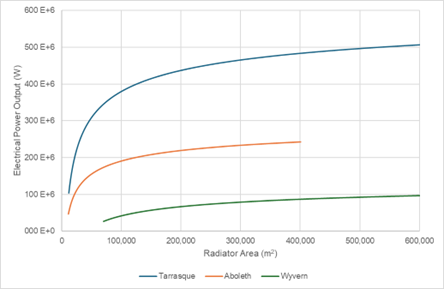
The efficiency of nuclear reactors at converting the produced Thermal Power into Electrical Power is governed by how cool the reactor runs. Therefore, Fission Frontiers recommends that radiators are used to control the Output Temperature where a larger radiator area runs cooler, improving the conversion efficiency of the system and therefore the Electrical Power it produces. Fission Frontiers provides an area of radiators as specified by the client depending on their needs.
The Electrical Power produced for each reactor can be estimated with the formula below:
Electrical Power (MW) = A ln(Radiating Area (m²)) – B
Fission Frontiers has calculated the abstract values A and B for each reactor as shown below, which consider the relevant Thermal Power and Output Temperature (these are also given for reference only).
Reactor | Thermal Power (MW) | Output Temperature (K) | A | B | Radiating Area bounds (m²) |
Tarasque | 1000 | 1300 | 104.6 | 842.2 | 12,000 – 600,000 |
Aboleth | 500 | 1100 | 55.59 | 445.2 | 12,000 – 400,000 |
Wyvern | 250 | 600 | 32.46 | 331.8 | 70,000 – 600,000 |
To better understand the relationship of this equation, the below graph shows the Power Output vs Radiator Area for all three reactors. The formula given and values A & B for each reactor are the best fit of these curves.